Fees & Processes (For Seller)
Home » Fees & Processes (For Seller)
Zero Fees Until the M&A Deal is Closed
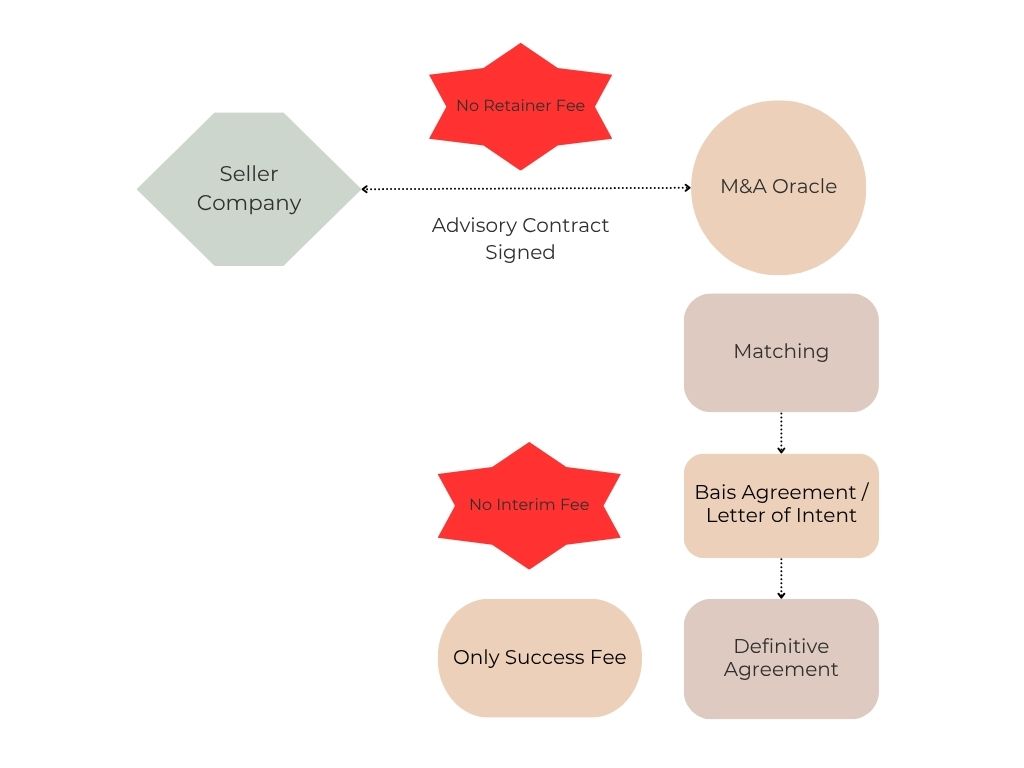
We operate on a completely success-based fee structure for sellers, meaning there are no upfront costs. We don’t charge a retainer, interim, or monthly fee. Our team works for free until the M&A deal is successfully concluded.
1. Retainer Fee
Typically, an M&A intermediary will require a retainer fee to begin their services. This fee can range from a few thousand to several hundred thousand Singapore dollars, depending on the company’s size. Even if the deal doesn’t go through, the retainer fee is generally non-refundable. At M&A Oracle, we charge no retainer fee, prioritizing our clients and ensuring no financial risk unless the deal is successful.
2. Intermediate Payment
An interim payment is usually required once a basic agreement is reached. This payment typically ranges from 10% to 20% of the success fee. If the deal falls through after this point, the payment is not refunded. We believe that if the M&A doesn’t lead to a contract, it holds no value for the seller, so we do not charge any intermediate payments.
3. Monthly Fees
Monthly fees are often imposed as M&A negotiations progress, with costs that continue regardless of the outcome. Even if a deal doesn’t close, these fees are generally not refunded. However, we do not charge any monthly fees. We work on a purely performance-based system.
Key Benefits of M&A
Oracle’s Performance-Based Fee System
Many M&A advisory firms claim to use a success-based fee model, but often, they still charge retainer, interim, or monthly fees. We believe that a fee structure that forces sellers to pay for services regardless of results is a major flaw in the M&A industry.
M&A Oracle has been using a fully performance-based fee model from the beginning.
1.
No Payment Required Until the Deal is Closed
Unlike many firms that charge retainer, interim, and monthly fees, we don’t require any upfront payments. If the M&A deal isn’t closed, we don’t charge a penny.
2.
Accurate Pricing and Clear Transferability
Some intermediaries charge retainer fees just to meet quotas, which can lead them to overstate the transfer price or misrepresent the potential value. At M&A Oracle, we are committed to honest discussions about the appropriate transfer price and the deal’s feasibility, ensuring a more transparent process and better outcomes for our clients.
3.
Access to a Larger Pool of Potential Buyers
We don’t charge buyers a retainer fee, which can often deter them from pursuing an acquisition. This approach allows us to connect you with a wider range of potential buyers, increasing the likelihood of a successful match.
4.
Faster Deal Closures
Many M&A intermediaries make their fee structure unclear, leading to time-consuming discussions and negotiations. Because we don’t charge retainer, interim, or monthly fees, we can start immediately, speeding up the process and enabling us to close deals in as little as 63 days from the initial request to the project contract.
Our Fee Structure for Transferor (Seller) Companies
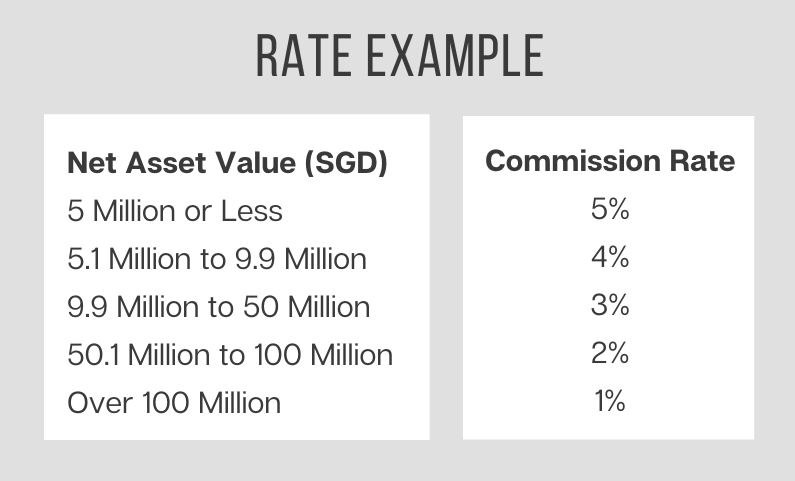
While most intermediary firms calculate their fees based on the net asset value plus debt (total assets), we base our brokerage fees strictly on the net asset value, excluding liabilities like debt.
This results in a lower fee compared to other firms that include total assets when calculating the fee.
*Minimum brokerage fee is S$250,000
The fee structure outlined in the above is specified in the general advisory agreement between our company and the client and may be adjusted after prior notice in special circumstances.
For cross-border transactions, the fee structure may vary. Please reach out to our company for more information.
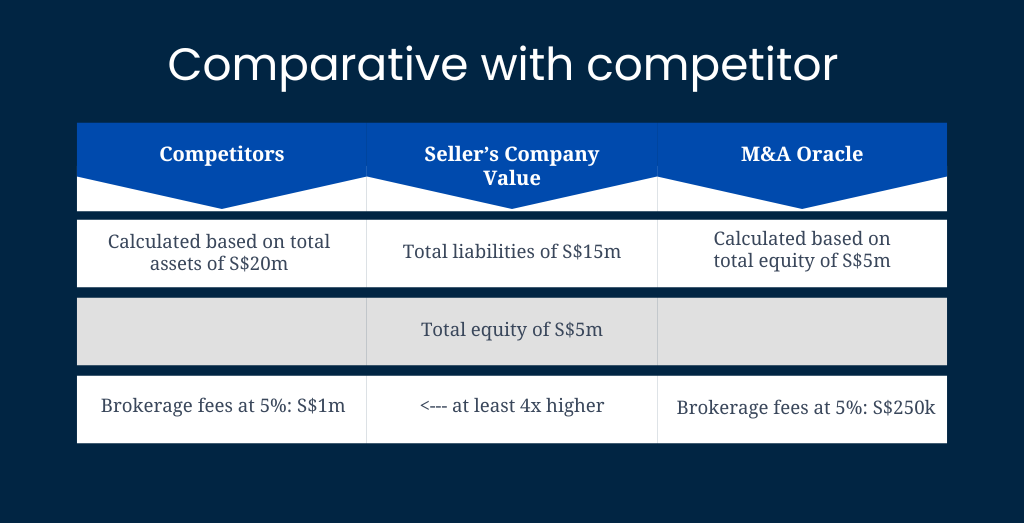
We don’t charge retainer or interim fees, which helps keep your costs lower compared to intermediaries that have such charges. Additionally, since our fee structure is based on the net asset value, it remains unchanged, even if there’s debt involved.
Our fees are lower because we focus on delivering high-quality results, and each adviser handles a significantly higher volume of annual contracts compared to typical M&A intermediaries.
As one of Singaporean’s largest M&A platforms, we handle a large volume of deal inquiries daily. By continuously analyzing past data from our database, we can improve the precision of our matching process. Additionally, by optimizing inefficient workflows, we enhance operational efficiency.
These improvements allow us to reduce intermediary fees while maintaining high-quality service.